Quick answer
Medellín makes more sense by area than by checklist. El Poblado holds the food and the nightlife, Comuna 13 the recent history and the street art, Laureles the everyday neighborhood rhythm, downtown the museums and architecture, and the eastern hills the viewpoints over the valley.
A fitting way to close any route: see the whole city from above at Mal de Ojo, a rooftop in Medellín.
Medellín is built inside a narrow valley, which creates a curious effect for visitors: almost everything is close in a straight line, yet each area sits at a different altitude and feels like a separate city. That is why a loose list of sights gets you very little, while organizing the trip by area gets you a lot.
This guide walks through the five areas that are genuinely worth your time, what each one offers, how long to spend there and how to chain them together without losing half a day in transit. At the end we explain why so many routes finish on the terrace of a rooftop in Medellín looking out at the lit-up valley.
How is Medellín laid out for a visitor?
The Aburrá valley runs south to north and the Medellín river splits it down the middle. The metro follows that axis, so line A works as the city’s spine: El Poblado and Envigado to the south, the institutional city in the center and the cultural parks to the north. Line B crosses west and connects with Laureles and with the cable car that climbs to Comuna 13.
The practical rule is simple: as long as you move along the metro axis, trips are fast and cheap. Once you leave it (climbing the eastern hills, for example) the time multiplies because of traffic and the gradient.
Medellín sits at around 1,500 meters above sea level and its average temperature hovers near 22 degrees Celsius all year. But the high eastern areas can be several degrees cooler once night falls. If your plan includes a terrace or a viewpoint, bring a light jacket.
What to see in El Poblado
El Poblado is comuna 14 and the area where most visitors stay. It climbs from Avenida Las Vegas toward the eastern hills, and that topography explains its greatest asset: almost every terrace has a view.
Inside El Poblado very different neighborhoods live side by side. Provenza and Parque Lleras are the busiest, packing restaurants, bars and design shops into a few blocks. Manila keeps old houses turned into cafes and signature kitchens. Astorga and Los Balsos are residential, tree-lined and quiet, with the best balance between calm and view.
- Walk Provenza and Parque Lleras The most concentrated circuit of restaurants, bars and shops. Great for an afternoon, though it gets very crowded from Thursday to Saturday.
- Cross over to Manila Two blocks from Lleras, with converted old houses, specialty coffee and signature cooking in a slower setting.
- Climb toward Astorga and Los Balsos Tree-lined streets, exposed brick and a steady slope: as you climb, the valley opens up and the panoramic terraces appear.
- Finish at a rooftop for sunset The altitude of the area turns the end of the day into the best moment: golden light over the mountains and then the valley lighting up.
What to see in Comuna 13
Comuna 13 (San Javier) is the visit that leaves the deepest mark on first-time travelers. It is a hillside neighborhood on the western side of the valley that lived through one of the hardest chapters of the city’s urban conflict and today stands as a reference for social transformation, street art and music.
You explore it by riding its open-air escalators, which cover the equivalent of a twenty-story building and connect the upper sectors with the rest of the city. Along the way there are murals, ice cream and juice stalls, viewpoints and dance and rap performances.
The route gains enormously with a guide from the neighborhood itself: the story behind each mural is half the visit. Go on a weekday and in the morning if you can, because on weekend afternoons the escalators fill up and the conversation gets lost.
What to see in downtown Medellín
Downtown holds the history, the architecture and the museums. It is the densest area and also the most chaotic, so it works best as a short daytime route.
| Spot | What it is | Time to spend |
|---|---|---|
| Plaza Botero | Twenty-three open-air Fernando Botero sculptures | 30 to 45 minutes |
| Museo de Antioquia | The city’s best art collection, facing the plaza | 2 hours |
| Palacio de la Cultura | Flemish neo-gothic architecture, a downtown icon | 30 minutes |
| Parque de las Luces | A forest of lit columns beside the old station | 30 minutes |
| Parque Berrío | The historic heart of the city, right by the metro | In passing |
Downtown is walkable between the Parque Berrío and San Antonio metro stations. It is a daytime route: as the afternoon ends the area changes and it is better to move south or west for the evening.
What to see in Laureles and Estadio
Laureles is the counterpoint to El Poblado: flat, laid out in circles and grids, full of trees and with real neighborhood life. It has been recognized as one of the world’s most interesting neighborhoods for its mix of modern architecture, human-scale commerce and walkable streets.
La 70 is its best-known avenue, with bars, restaurants and the football atmosphere of the Atanasio Girardot stadium. Primero de Mayo and the Laureles park are the daytime plan: coffee, bakeries and mango-tree shade. If you want to see how the city actually lives beyond the tourist circuit, this is the area.
What to see from above: viewpoints and the east
The valley is so enclosed that Medellín makes the most sense from height. There are three ways to gain that perspective.
| Option | What it offers | Best moment |
|---|---|---|
| Cable car (lines J, K, H) | Aerial view of the valley and the hillside neighborhoods | A clear morning |
| Parque Arví | Cloud forest at 2,500 meters, reached by cable car | A full day |
| Vía Las Palmas | Roadside viewpoints over the entire valley | Sunset |
| El Poblado rooftops | Panoramic views with food and cocktails | Sunset and evening |
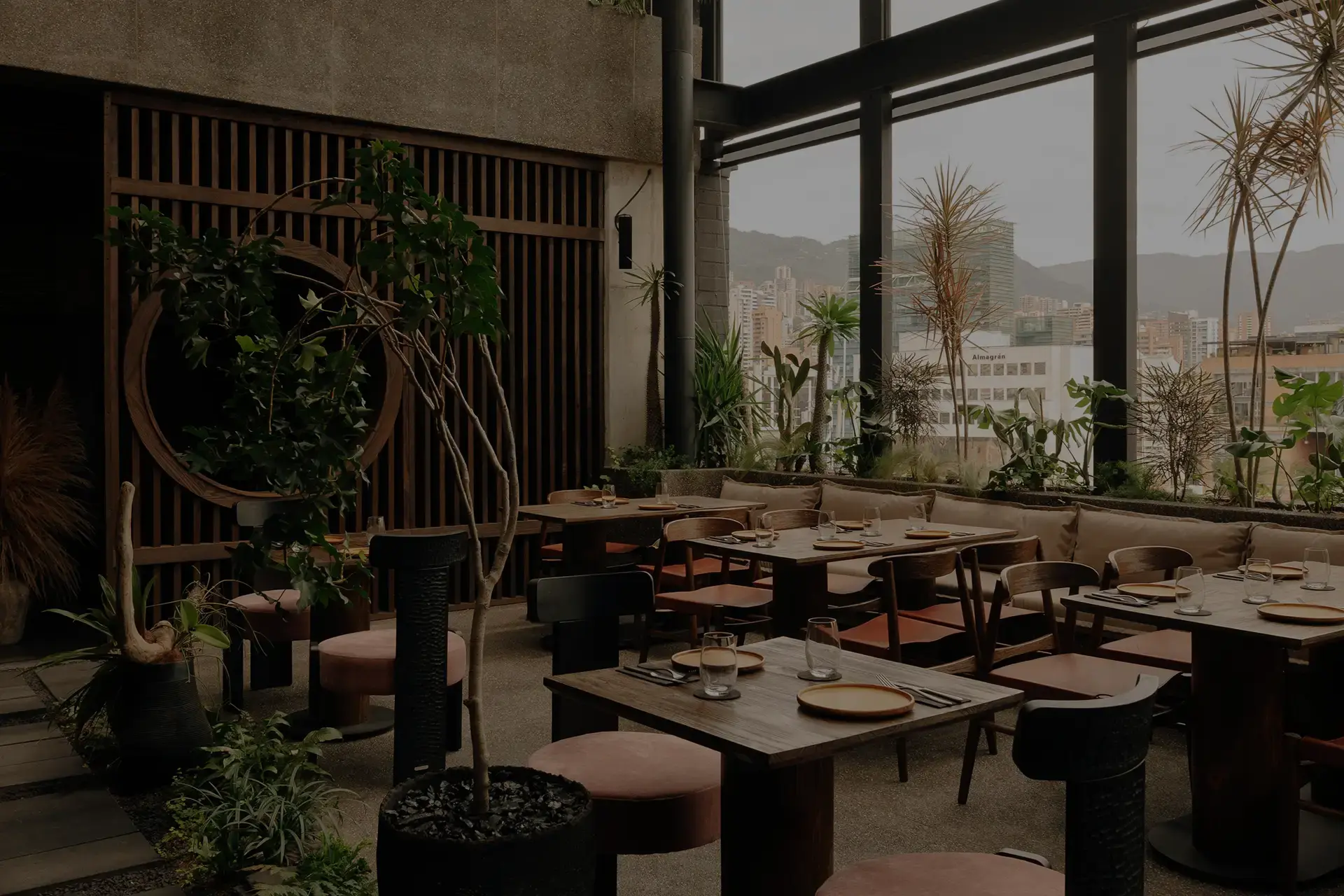
Rooftops are the most comfortable version of that view: they do not depend on mountain weather or park opening hours, and they pair the landscape with dinner. Mal de Ojo, for instance, sits in Astorga, at exactly the right height to watch El Poblado open toward downtown, with Mexican-Asian fusion cooking and signature cocktails.
How to plan the route in three days
- Day 1: El Poblado A quiet morning through Astorga and Manila, an afternoon in Provenza and Parque Lleras, and a rooftop close at sunset.
- Day 2: Comuna 13 and the west A guided morning route through Comuna 13, then afternoon and evening in Laureles and La 70 to see the neighborhood city.
- Day 3: downtown and height Museo de Antioquia and Plaza Botero in the morning, cable car or Parque Arví in the afternoon and dinner in El Poblado.
Close your Medellín route with a view over the valley
Mexican-Asian fusion cooking, signature cocktails and a terrace in Astorga with a panoramic view over El Poblado.
Book your tableFrequently asked questions
How many days do you need to see Medellín?
Three full days cover El Poblado, Comuna 13, downtown and one viewpoint. With four or five you can add Laureles, Parque Arví and a day trip to nearby towns such as Guatapé or Santa Fe de Antioquia.
What is the best area to stay in Medellín?
El Poblado is the most practical choice for its hotels, restaurants and metro connections. Laureles is the alternative for anyone who prefers neighborhood atmosphere, flat streets and lower prices.
Can you get around Medellín by metro?
Yes. Line A covers the south-north axis (El Poblado, downtown and the north), line B runs west and the cable cars climb the hillsides. It is the fastest, cleanest and cheapest transport in the city.
When is the best time to visit Medellín?
The temperature is stable all year, so rainfall matters more: the driest months are December, January, July and August. August also brings the Feria de las Flores, the biggest festival in the city.
In short
- Medellín is best explored by area: each one has its own altitude, rhythm and hours.
- El Poblado for eating and going out, Comuna 13 for history and street art.
- Downtown for museums and architecture, Laureles for everyday neighborhood life.
- The valley makes sense from above: cable car, Las Palmas or a rooftop at sunset.